Keep left sign: what it means
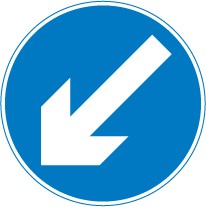
The keep left sign means you must pass to the left of it, usually round a traffic island or bollard. It is a blue circle, so it is an order.
Last checked against the sources: · Report a mistake
What it means
In the Highway Code, blue circles with no red border mostly give a positive instruction. The arrow shows which side to pass. With the symbol reversed, the same sign means keep right.
A different blue sign, with two arrows, means vehicles may pass on either side to reach the same destination.
Where you see it
Typically on traffic islands and bollards in the middle of the road.
A common mistake
Reading it as turn left. It does not tell you to turn; it tells you which side of the island to pass. The signs that order you to turn left have a horizontal or bent arrow instead.
Quick quiz
A blue circle with a white arrow pointing down to the left stands on a traffic island. What should you do?
- Take the next left turn
- Pass to the left of the island
- Pass on either side
Show answer
B. Pass to the left of the island. The arrow points to the side you must pass. Only the sign with two arrows lets you pass either side. Source: The Highway Code, rule 109, GOV.UK; Know your traffic signs: regulatory signs, GOV.UK; The Highway Code: traffic signs, GOV.UK; Traffic sign images, Department for Transport, GOV.UK
Compare with
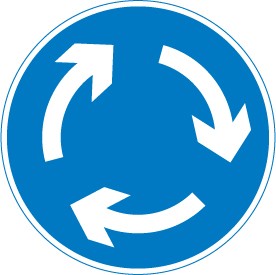 Mini-roundabout signGive way to traffic from your immediate right.
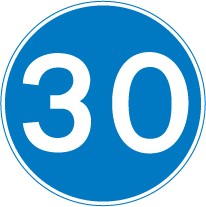 Minimum speed limit signGo at least this fast, if it is safe.
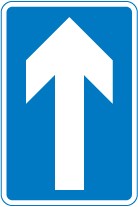 One-way traffic signAll traffic goes in the direction of the arrow.
Next in regulatory signs: Mini-roundabout sign. See all regulatory signs or the full road signs list.
Want to test someone else? Play a road-sign quiz with friends and family.
Sources
- The Highway Code, rule 109, GOV.UK
- Know your traffic signs: regulatory signs, GOV.UK
- The Highway Code: traffic signs, GOV.UK
- Traffic sign images, Department for Transport, GOV.UK
Contains public sector information licensed under the Open Government Licence v3.0. Traffic sign images are Crown copyright, from the Department for Transport. Sources and image credits.