Yellow center lines: what they mean
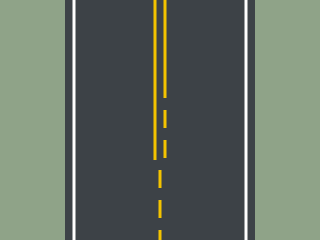
Yellow center lines separate traffic going in opposite directions. A broken line on your side means you may pass with care; a solid line on your side means you may not.
Last checked against the sources: · Report a mistake
What it means
MUTCD Section 3A.03: yellow lines separate traffic traveling in opposite directions. Section 3B.01 sets out the center lines on two-lane, two-way roads: a single broken yellow line, where passing with care is allowed in both directions; a broken line beside a solid line, where traffic next to the broken line may pass but traffic next to the solid line may not; and double solid yellow lines, where passing is prohibited in both directions.
A single solid yellow line is not used as a center line on a two-way road (Section 3B.01).
Where you see it
Down the middle of two-way roads. No-passing zones are marked at curves, hills and other places where you cannot see far enough ahead (Section 3B.03).
A common mistake
Looking at the wrong line. Only the line on your side of the road tells you whether you may pass.
Quick quiz
On a two-lane road, a solid yellow line is next to your lane and a broken one is next to the other lane. May you pass?
- No
- Yes, when it is clear
- Only during the day
Show answer
A. No. Section 3B.01: passing is prohibited for traffic traveling next to the solid line. Source: MUTCD 11th Edition, Part 3, Markings: Sections 3A.03, 3B.01, 3B.03, FHWA; MUTCD 11th Edition, FHWA
Compare with
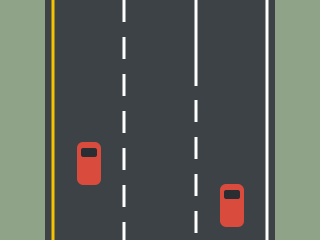 White lane linesWhite lines separate lanes going the same way.
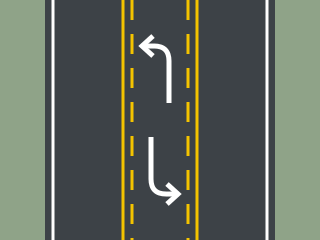 Two-way left-turn laneA center lane for left turns from both directions.
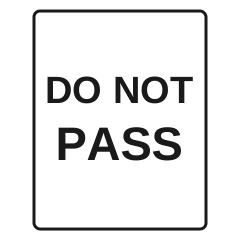 Do not pass signPassing is not allowed here.
Next in pavement markings: White lane lines. See all pavement markings or the full road signs list.
Want to test someone else? Play a road-sign quiz with friends and family.
Sources
- MUTCD 11th Edition, Part 3, Markings: Sections 3A.03, 3B.01, 3B.03, FHWA
- MUTCD 11th Edition, FHWA. FHWA lists the current version as the 11th Edition with Revision 1, dated December 2025
Sign pictures are our own simplified drawings of the MUTCD designs, which are in the public domain (MUTCD Section 1D.06). Sources and image credits.