Texas permit practice test: 40-question mock
20 Texas law questions and 20 rules-and-signs questions that apply in every state, scored against the DPS pass mark of 70 percent.
Checked against Texas law and the MUTCD · Report a mistake
Texas permit mock test
-
Emergency vehicles and crashes
In Texas, you are driving toward a block where a fire truck has stopped to answer a fire alarm. You are on a personal trip. What must you do?
- APark in that block if a space is open
- BDrive slowly through that block
- CFollow the truck into that block
- DKeep your vehicle out of that block
Answer and reason
D. Keep your vehicle out of that block. You may not drive into or park in the block where a fire apparatus has stopped to answer an alarm. Source: Texas Transportation Code § 545.407(a); Texas Driver Handbook, Chapter 4: Yield Right-of-Way to Emergency Vehicles
-
Learner and provisional licenses
You are 17 with a Texas provisional license, driving a car at 2 p.m. without a learner-qualified adult beside you. All your passengers would be 17-year-old friends who are not family members. How many may ride with you?
- AAt most 1 friend
- BAt most 3 friends
- CAs many friends as there are seat belts
- DAt most 2 friends
Answer and reason
A. At most 1 friend. Texas drivers under 18 may carry at most one passenger under 21 who is not family, unless properly supervised. Source: Texas Transportation Code § 545.424(a-1)(2)
-
Driver education
You have your Texas learner license with you. Your parent certifies a 22-year-old friend to supervise your 30 practice hours. The friend has been licensed and driving for 2 years, holds the proper license for the car, and sits beside you, alert, sober, and able to watch and respond to your driving. What else is required?
- AThe friend must also be related to you through the listed family relationships.
- BThe friend must also be your designated parent-taught instructor.
- CThe friend must also have at least 7 years of driving experience to supervise.
- DNo additional instructor designation is required for these practice hours.
Answer and reason
D. No additional instructor designation is required for these practice hours.. Practice may be supervised by a parent-certified adult at least 21 who has been licensed for at least 1 year. Source: Texas Transportation Code § 521.222(d)(2)(A)–(C); TDLR: Behind the Wheel Instruction (Practice Hours Log)
-
Seat belts and child seats
On an ordinary family trip, a 7-year-old who is 4 feet 10 inches tall rides in a seat that has a safety belt. What does Texas law require at minimum?
- AIn a child safety seat
- BIn a booster seat
- COn an adult’s lap
- DIn a safety belt
Answer and reason
D. In a safety belt. Under 8 needs a child seat unless taller than 4 feet 9 inches; a taller child must wear a safety belt. Source: Texas Transportation Code § 545.412(a); Texas Transportation Code § 545.413(b); Texas Driver Handbook, Chapter 14: Safety Belts
-
Alcohol and DWI
A driver is arrested for DWI in Texas and refuses a breath or blood specimen. The driver’s record shows one alcohol-related enforcement contact within the last 10 years. How long is the license suspension?
- A90 days
- B1 year
- C180 days
- D2 years
Answer and reason
D. 2 years. A refusal with a prior alcohol or drug enforcement contact suspends the license for two years. Source: Texas Transportation Code § 724.035(b)
-
Driver education
You are 17 and have completed Texas parent-taught driver education, including the highway sign and traffic law tests through your licensed course provider. Can Texas waive your driving test because you completed the course?
- ANo; the driving test cannot be waived under age 18.
- BYes; passing the course also replaces the driving test.
- CYes; your parent may approve a driving test waiver.
- DYes; completing the Impact program replaces the driving test.
Answer and reason
A. No; the driving test cannot be waived under age 18.. Texas cannot waive the required driving test for an applicant under 18. Source: Texas Transportation Code § 521.165(d)
-
Parking
In Texas, how far must you keep your parked car from a roadside stop sign or traffic signal when approaching it?
- A15 feet
- B50 feet
- C20 feet
- D30 feet
Answer and reason
D. 30 feet. Do not park within 30 feet on the approach to a stop sign or traffic signal. Source: Texas Transportation Code § 545.302(b)(4)
-
Speed limits
Fog limits visibility on a Texas highway posted at 70 mph. You drive 60 mph. Can you be ticketed for speed?
- ANo — 60 mph is always reasonable on a highway
- BNo — only driving over the limit can be ticketed
- CNo — any speed below the posted limit is lawful
- DYes — your speed must be reasonable and prudent for the fog
Answer and reason
D. Yes — your speed must be reasonable and prudent for the fog. Even below the posted limit, speed must be reasonable and prudent for the conditions. Source: Texas Transportation Code § 545.351(a)
-
Sharing the road
In Texas, you approach a utility service truck using approved warning lights beside the road. You stay in the lane closest to it, and no officer directs you otherwise. The posted limit is 20 mph. What is your maximum speed?
- A10 mph
- B0 mph (full stop)
- C15 mph
- D5 mph
Answer and reason
D. 5 mph. When the posted limit is under 25 mph, slow to 5 mph rather than 20 mph below it. Source: Texas Transportation Code § 545.157(b)(2)(B)
-
Headlights
In Texas, "nighttime" for headlight use begins and ends when?
- AOne-half hour before sunset to one-half hour after sunrise
- BOne hour after sunset to one hour before sunrise
- COne-half hour after sunset to one-half hour before sunrise
- DAt sunset and sunrise
Answer and reason
C. One-half hour after sunset to one-half hour before sunrise. Nighttime is from one-half hour after sunset to one-half hour before sunrise. Source: Texas Transportation Code § 541.401(5); Texas Transportation Code § 547.302(a)(1); Texas Driver Handbook, Chapter 9: Headlights
-
Insurance
After a Texas crash, the other driver asks to see proof of financial responsibility for your car. You have valid proof with you. What does Texas law require?
- ASend it only after an insurance claim is filed
- BShow it only if you caused the collision
- CShow it only if an officer also requests it
- DShow the other driver your proof
Answer and reason
D. Show the other driver your proof. Texas requires drivers to show financial responsibility evidence on request to a person involved in their collision. Source: Texas Transportation Code § 601.053(a)
-
Phones and distraction
You are 17 with a Texas provisional license and are driving a car. There is no emergency. Your phone offers hands-free calling. What does Texas law allow?
- AYou must wait until you stop driving.
- BYou may call after holding your license for 12 months.
- CYou may call if you use only voice commands.
- DYou may call if the phone stays in its mount.
Answer and reason
A. You must wait until you stop driving.. Texas drivers under 18 may use a wireless device, including hands-free, only in an emergency. Source: Texas Transportation Code § 545.424(a); Texas Transportation Code § 545.424(f)
-
Learner and provisional licenses
You are 15 and practicing on a Texas highway with a learner license. Each adult listed has the right driver’s license, sits beside you, and stays alert and sober. Who meets both the minimum age and driving experience requirements?
- AAn adult age 20 with 3 years of driving experience
- BAn adult age 21 with 6 months of driving experience
- CAn adult age 21 with 1 year of driving experience
- DAn adult age 18 with 2 years of driving experience
Answer and reason
C. An adult age 21 with 1 year of driving experience. A Texas learner supervisor must be at least 21 and have at least one year of driving experience. Source: Texas Transportation Code § 521.222(d)(2)(B)-(C)
-
Alcohol and DWI
You are arrested in Texas for driving while intoxicated. Under the implied consent law, what have you automatically agreed to submit to?
- AA urine sample only
- BA breath or blood specimen for testing
- CA field sobriety walk and turn
- DA search of your whole vehicle
Answer and reason
B. A breath or blood specimen for testing. A person arrested for DWI is deemed to consent to a breath or blood specimen. Source: Texas Transportation Code § 724.011(a)
-
Phones and distraction
You are 25 and drive a car on Texas public high school property. The school’s designated crossing zone has its reduced speed limit in effect. Under the state school-property phone rule, may you hold your phone for a routine personal call?
- ANo, you may use a phone only if stopped or hands-free.
- BYes, if no students are present.
- CYes, the hand-held ban applies only on the street, not school property.
- DYes, because school property is not a school crossing zone.
Answer and reason
A. No, you may use a phone only if stopped or hands-free.. On school property during the reduced school speed limit, hand-held phone use is banned unless stopped or hands-free. Source: Texas Transportation Code § 545.4252(b)
-
Sharing the road
In Texas, you approach a stopped tow truck using authorized flashing lights. You are in the lane closest to it on a highway with two lanes going your way. No officer directs you otherwise. Instead of slowing down, what may you do?
- APull to the right edge and stop
- BFollow at least 500 feet behind it
- CStop and wait for a police officer
- DMove out of the lane next to the truck
Answer and reason
D. Move out of the lane next to the truck. On a road with two or more lanes your way, vacate the lane closest to a covered stopped vehicle, or slow down. Source: Texas Transportation Code § 545.157(b)(1); Texas Driver Handbook, Chapter 8: Speed Limits; Slow Down or Move Over
-
Learner and provisional licenses
You are 16 and applying for a Texas driver’s license. Your parent has custody of you, and no agent has power of attorney. Who must sign your application with you?
- AYour parent who has custody
- BAny licensed adult who is at least 21
- CYour employer, even though your parent has custody
- DYour driving instructor instead of your parent
Answer and reason
A. Your parent who has custody. A Texas applicant under 18 needs the custodial parent or guardian’s signature, or an authorized parent’s agent. Source: Texas Transportation Code § 521.145(a)(1)
-
Emergency vehicles and crashes
In Texas, you damage an unattended car while driving a borrowed car. You stop but cannot locate the other car’s owner or driver. You securely attach a visible note describing the collision. Whose names and addresses must the note include?
- AOnly yours, because you were driving when the collision happened
- BYours and a witness’s, instead of the borrowed car owner’s
- CYours and the borrowed car owner’s
- DOnly the borrowed car owner’s, because that person owns the car
Answer and reason
C. Yours and the borrowed car owner’s. The note must give the driver’s and striking vehicle owner’s names and addresses, plus the collision circumstances. Source: Texas Transportation Code § 550.024(a)(2)
-
Insurance
What is the fine range for a second Texas conviction for driving without the required insurance or other financial responsibility?
- AA fine of $175 to $350
- BA fine of $25 to $500
- CA fine of $350 to $1,000
- DA fine of $25 to $200
Answer and reason
C. A fine of $350 to $1,000. A repeat Texas conviction for driving without financial responsibility carries a fine of $350 to $1,000. Source: Texas Transportation Code § 601.191(c)
-
Speed limits
You drive a passenger car outside an urban district on a highway numbered by neither Texas nor the United States. With no different speed limit established, what is the default limit?
- A55 miles per hour
- B65 miles per hour
- C70 miles per hour
- D60 miles per hour
Answer and reason
D. 60 miles per hour. Outside an urban district, an unnumbered highway defaults to 60 mph unless another limit is set. Source: Texas Transportation Code § 545.352(b)(3)
-
Pavement markings
A center lane is bordered by solid and broken yellow lines on each side and shows left-turn arrows. What is it for?
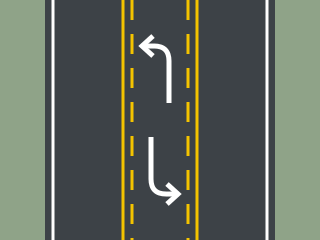
- ABuses and carpools only
- BParking while you run errands
- CLeft turns from either direction
- DPassing slower traffic on both sides
Answer and reason
C. Left turns from either direction. A center lane with left-turn arrows is a two-way left-turn lane for turning left from either direction. Source: MUTCD Section 3B.05 Pavement Markings for Two-Way Left-Turn Lanes
-
Night and bad weather
Heavy snow is reducing visibility while you drive. You need your headlights to see and be seen. Which lighting choice is appropriate?
- ALow-beam headlights
- BDaytime running lights without other lighting
- CParking lights without the headlights
- DHigh beams for the strongest possible light
Answer and reason
A. Low-beam headlights. Use low-beam headlights when snow reduces visibility so you can see and other drivers can see you. Source: California Driver Handbook (California DMV): Signals, Horns, and Headlights: Using Your Headlights; Texas Driver Handbook, Chapter 9: Some Special Driving Situations, Headlights; Florida Driver License Handbook (FLHSMV): Low Visibility; Night Driving
-
Passing
You want to pass a slow truck on a two-lane road, but you are nearing a hill crest where you cannot see oncoming traffic. What should you do?
- APass on the right shoulder instead
- BWait until you can see far enough to pass
- CPass quickly before you reach the crest
- DFollow close behind and pass at the crest
Answer and reason
B. Wait until you can see far enough to pass. Do not pass where your view is blocked, such as near a hill crest, curve, intersection, or crossing. Source: UVC § 11-306(a)(1) Further limitations on driving on left of center of roadway (model law)
-
Speed and space
On a clear, dry highway you drive so slowly that a long line of cars builds up behind you, though no hazard or law requires it. What does the law say?
- AYou must match the fastest car’s speed
- BDo not block the normal flow of traffic
- CYou may drive any slow speed you choose
- DYou must pull over and stop completely
Answer and reason
B. Do not block the normal flow of traffic. Do not drive so slowly that you impede normal traffic, unless the slow speed is needed for safety or to obey the law. Source: UVC § 11-805 Minimum speed regulation (model law)
-
Distraction
You drop something on the floor while driving. What should you do?
- AStop in the middle of the lane to get it
- BLook down and grab it in one quick move
- CWait to pick it up until you stop safely
- DReach down quickly while watching the road
Answer and reason
C. Wait to pick it up until you stop safely. Wait to retrieve a dropped object until you can pull over and stop safely; reaching distracts you. Source: NHTSA: Distracted Driving, What Is Distracted Driving?
-
Right-of-way
At a marked crosswalk with no traffic signals, a pedestrian is already crossing in your lane. You have enough distance to stop safely. Which action gives the pedestrian the right-of-way?
- ASteer into the next lane to pass the pedestrian
- BStop and let the pedestrian cross
- CSound your horn and keep your current speed
- DContinue because your road has no stop sign
Answer and reason
B. Stop and let the pedestrian cross. Drivers must yield to pedestrians crossing in their path within an unsignalized crosswalk. Source: UVC § 11-502(a) Pedestrians’ right of way in crosswalks (model law)
-
Seat belts and child safety
Every rear seat in your car allows a correct car-seat installation. Which spot is unsafe for a rear-facing child safety seat?
- ABeside a rear-side window
- BThe middle seat in the back row
- CBehind the driver’s seat
- DFront seat, facing an active air bag
Answer and reason
D. Front seat, facing an active air bag. A rear-facing seat must never go in front of an active air bag, whose force can seriously injure a child. Source: NHTSA: Air Bags, The Topic — Protection
-
Sharing the road
Red lights are flashing at a railroad crossing, but the gate is still raised and you cannot see a train. No officer is directing traffic. What should you do?
- AStop only if a train becomes visible near the crossing
- BCross slowly while watching for a train in both directions
- CContinue across because the raised gate permits travel
- DStop before the tracks; wait until the lights stop and it is safe
Answer and reason
D. Stop before the tracks; wait until the lights stop and it is safe. Flashing crossing lights mean stop before the tracks; a raised gate does not cancel them. Source: UVC § 11-701(a) Obedience to signal indicating approach of train (model law)
-
Pavement markings
A white arrow painted in your lane curves left. What does it tell you?
- AThis lane is for left turns
- BYou may turn left or go straight
- CThe road curves left up ahead
- DLeft turns are forbidden here
Answer and reason
A. This lane is for left turns. A lane-use arrow shows the movements allowed or required in that lane. Source: MUTCD Section 3B.23 Lane-Use Arrows
-
Traffic signals
A steady yellow left-turn arrow is showing. What does it tell you?
- ALeft turns are now forbidden
- BYou now have the right-of-way to turn
- CThe left-turn movement is ending; prepare to stop
- DThe arrow is about to turn green
Answer and reason
C. The left-turn movement is ending; prepare to stop. A steady yellow arrow warns that the current left-turn movement is ending; prepare to stop. Source: MUTCD Section 4A.03 Meanings of Steady Vehicular Signal Indications
-
Alcohol and drugs
What happens when you mix alcohol with another drug before you drive?
- AThey cancel each other’s effects
- BOnly the alcohol matters
- CThere is no added risk
- DThe effects can get stronger
Answer and reason
D. The effects can get stronger. Mixing alcohol with other drugs can amplify the impairing effects of each, making driving more dangerous. Source: NHTSA: Drug-Impaired Driving, Many Substances Can Impair Driving
-
Intersections and turns
You plan to turn onto a one-way street. Its permitted traffic direction runs from your left to your right. There are no other turn restrictions. Which turn follows that street’s legal direction?
- AA left turn across the near side of the street
- BA left turn followed by an immediate lane change
- CEither turn if the destination street is empty
- DA right turn
Answer and reason
D. A right turn. Enter a one-way street only in its designated direction of travel. Source: UVC § 11-308(b) One-way roadways and rotary traffic islands (model law)
-
Intersections and turns
You face a steady circular green and plan a permitted left turn. An oncoming car is close enough to conflict with your turn. A pedestrian is also lawfully crossing your turning path. What must happen before you turn?
- AYou yield until each conflict clears
- BThe oncoming car passes; the pedestrian must wait
- CYou signal; the car and pedestrian must then yield
- DThe pedestrian clears your path; the car must yield
Answer and reason
A. You yield until each conflict clears. On a circular green, left turns yield to conflicting oncoming vehicles and pedestrians lawfully in the crosswalk. Source: MUTCD Section 4A.03 Meanings of Steady Vehicular Signal Indications; UVC § 11-402 Vehicle turning left (model law)
-
Emergencies
You slept very little, drank coffee, and now begin drifting out of your lane. A designated rest area is just ahead. What is the safest response?
- AKeep driving because the coffee will prevent sleep
- BTurn the music louder and increase your driving speed
- CPull into the rest area and stop to rest
- DOpen the windows and continue until your destination
Answer and reason
C. Pull into the rest area and stop to rest. Coffee alone may not prevent microsleeps; stop in a safe place when sleepiness affects your driving. Source: NHTSA: Drowsy Driving, Short-Term Interventions
-
Highways
You are on a divided highway with a grassy median between the two roadways, and you miss your turn. What may you do?
- ACross the median where the grass is low
- BDrive the wrong way briefly to an opening
- CUse the next crossover marked for emergency vehicles only
- DContinue to an opening or intersection where crossing is permitted, and turn only when safe
Answer and reason
D. Continue to an opening or intersection where crossing is permitted, and turn only when safe. Stay on your roadway until you reach a permitted crossing, and turn only when safe. Source: UVC § 11-311 Driving on divided highways (model law)
-
Traffic signals
A steady green arrow points left while the circular light is red. A pedestrian is still crossing directly in your intended turning path. What must you do?
- ATurn left and stop inside the crosswalk
- BTurn left now; the arrow gives you the right-of-way
- CGo straight instead, since the arrow is on
- DYield to the pedestrian, then turn when safe and permitted
Answer and reason
D. Yield to the pedestrian, then turn when safe and permitted. A green arrow allows the left turn, but you must still yield to pedestrians in the crosswalk. Source: MUTCD Section 4A.03 Meanings of Steady Vehicular Signal Indications
-
Right-of-way
A car ahead has stopped at a marked crosswalk to let a pedestrian cross. You approach from behind, and the next lane is open. What must you do?
- APass in the open lane after sounding your horn
- BPass once your own lane appears clear
- CWait behind the stopped car
- DPass slowly if the pedestrian is hidden from view
Answer and reason
C. Wait behind the stopped car. Never overtake a vehicle stopped at a crosswalk to let a pedestrian cross. Source: UVC § 11-502(d) Pedestrians’ right of way in crosswalks (model law)
-
Speed and space
Which statement about your speed is correct?
- AYou must never drive below the posted limit, even in bad weather
- BThe posted limit is only a suggestion
- CDrive at a safe speed for conditions; don’t needlessly block normal traffic
- DYou must match the speed of the fastest car
Answer and reason
C. Drive at a safe speed for conditions; don’t needlessly block normal traffic. Drive at a safe speed for conditions, even below the limit, but don’t needlessly impede normal traffic. Source: UVC § 11-801 Basic rule (model law); UVC § 11-805 Minimum speed regulation (model law)
-
Signs
A white sign reads DO NOT PASS. What does it mean?
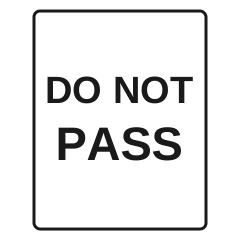
- ADo not overtake other vehicles
- BDo not turn left here
- CDo not park on the shoulder
- DDo not follow too closely
Answer and reason
A. Do not overtake other vehicles. DO NOT PASS means you may not overtake another vehicle in that zone. Source: MUTCD Section 2B.36 DO NOT PASS Sign (R4-1)
-
Sharing the road
A motorcycle is traveling ahead in your lane. There appears to be enough room for your car beside it. How should you treat the motorcycle’s lane space?
- AMove beside it after sounding a brief horn warning
- BShare its lane whenever your car can fit beside it
- CAllow the motorcycle full use of its lane
- DUse its unused lane space when traffic is moving slowly
Answer and reason
C. Allow the motorcycle full use of its lane. A motorcycle is entitled to full use of a lane; a car must not crowd into that space. Source: UVC § 11-1303(a) Operating motorcycles on roadways laned for traffic (model law)
Answer one question at a time. Nothing you pick is saved or sent anywhere.
Keep practicing for free
- You’ll be able to play live with friends, free
- Pro will bring back your mistakes until you get them right
- It will be one purchase, no subscription
The DriveQuiz app for iPhone and Android is coming soon.
Texas test facts
- Pass mark: 70 percent (DL-7 handbook)
- Minimum age: 15 (learner license) § 521.222
- Before the test: classroom phase of an approved driver education course § 521.222
- Test length: not stated in the Texas Driver Handbook, the Texas Administrative Code or the Transportation Code (DL-7 handbook; Transportation Code)
- Where: a Texas DPS driver license office (DPS teen page)
The Texas Driver Handbook, the Texas Administrative Code and the Transportation Code do not state how many questions the test has. This mock has 40 questions for practice; it does not claim to match the real test’s length. The Texas Driver Handbook gives the pass mark as 70 percent.
What this mock mixes
Half the questions draw on Texas law for learners. The other half cover rules and signs that apply in every state. Each answer explains the choice and links to the source behind it, so you can read more about anything you want to revisit.
Use your result to choose what to study next. Reaching the practice score cannot promise a result on the real test. Read the Texas Driver Handbook alongside these questions and check the rules that apply to your license.
Our questions are our own, drafted with AI help from the Texas statutes, the Texas Driver Handbook, TDLR, the MUTCD and other cited sources, and checked against them. No driving instructor, DPS or TDLR has reviewed them: how we write and check our questions.
More practice
Try the 25-question all-states sample.
- The Texas permit test explained: the learner license and what DPS publishes about the knowledge test.
- Road signs quiz: 31 signs and markings with pictures.
- Permit test pass-mark checker: work out a score from a percentage.
Sources
- California Driver Handbook (California DMV)
- Florida Driver License Handbook (FLHSMV)
- MUTCD 11th Edition with Revision 1 (FHWA, December 2025)
- NHTSA: Air Bags
- NHTSA: Distracted Driving
- NHTSA: Drowsy Driving
- NHTSA: Drug-Impaired Driving
- TDLR: Behind the Wheel Instruction
- Texas Driver Handbook (DL-7, rev. January 2026)
- Texas Transportation Code
- Texas Transportation Code
- Texas Transportation Code
- Texas Transportation Code
- Texas Transportation Code
- Texas Transportation Code
- Texas Transportation Code
- Uniform Vehicle Code (2000), Chapter 11 Rules of the Road (NCUTCD compilation 21B-ROR-02)